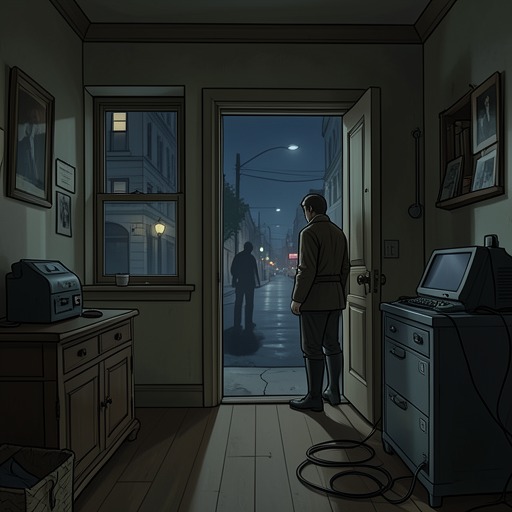
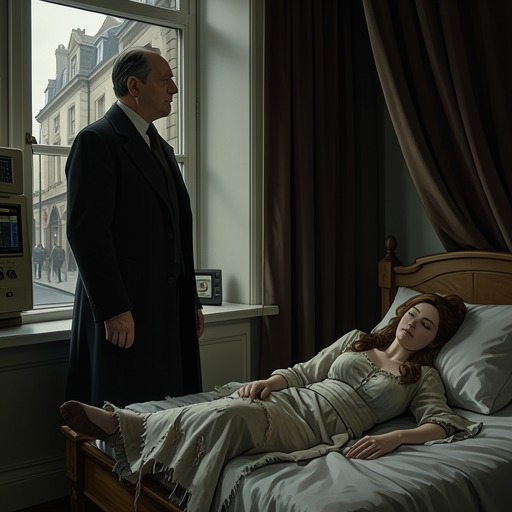
Hal Jeffries’s temporary immobilization
Rear WindowHal Jeffries’s temporary immobilization sharply restricts his movement, confining him to the route between his bed and the window. The cast on his leg makes inactivity a practical condition of daily life, and the rear window becomes both the limit of his world and his main occupation. His confinement is temporary, but its influence on what he notices around him is decisive.
Identity and Conditions
Jeffries describes his range of movement as strictly limited: he can get from the window to the bed and back, and nowhere else. The bay window is the best feature of his rear bedroom in warm weather, but it is unscreened. To keep insects out, he has to sit with the light off, making even this favored spot subject to the conditions imposed by his room and his injury.
His immobility also disrupts his ordinary habits. Accustomed to getting plenty of exercise, he cannot sleep; he has not acquired the habit of reading books to relieve boredom. The cast is therefore more than a medical detail: it alters the rhythm of his day and leaves him searching for something to do within a narrow physical perimeter.
Confinement and Observation
With movement reduced to the bed and window, Jeffries turns his attention outward. The rear-window dwellers become available to him as a pattern of comings and goings, daily habits, and activities. The watching begins as a response to boredom and restricted movement, rather than as an activity he presents as his original purpose. The window supplies a form of occupation, though its unscreened opening and the need to keep the room dark also mark the limits under which he observes.
This arrangement makes physical confinement consequential to the narrative: Jeffries’s reduced mobility holds him in place, while his attention travels across the neighboring windows. Observation fills hours that exercise and sleep no longer can. The immobilized body thus narrows his immediate world while directing his awareness toward the lives unfolding beyond it.
Change and Ending
Even after Inspector Boyne and the others have gone by nine, Jeffries remains in his chair, too keyed up to sleep. Sam enters and tells him that Doc Preston has arrived. The doctor comes in rubbing his hands and says that they can take the cast off Jeffries’s leg, adding that Jeffries must be tired of sitting there all day doing nothing.
The exchange signals a possible end to the restriction, but the passage stops at the prospect of removal rather than confirming that the cast has come off. The doctor’s remark also gives the confinement a mundane, physical endpoint: after the extraordinary intensity of the evening, the immediate change is simply that Jeffries may no longer have to spend his days sitting still.